
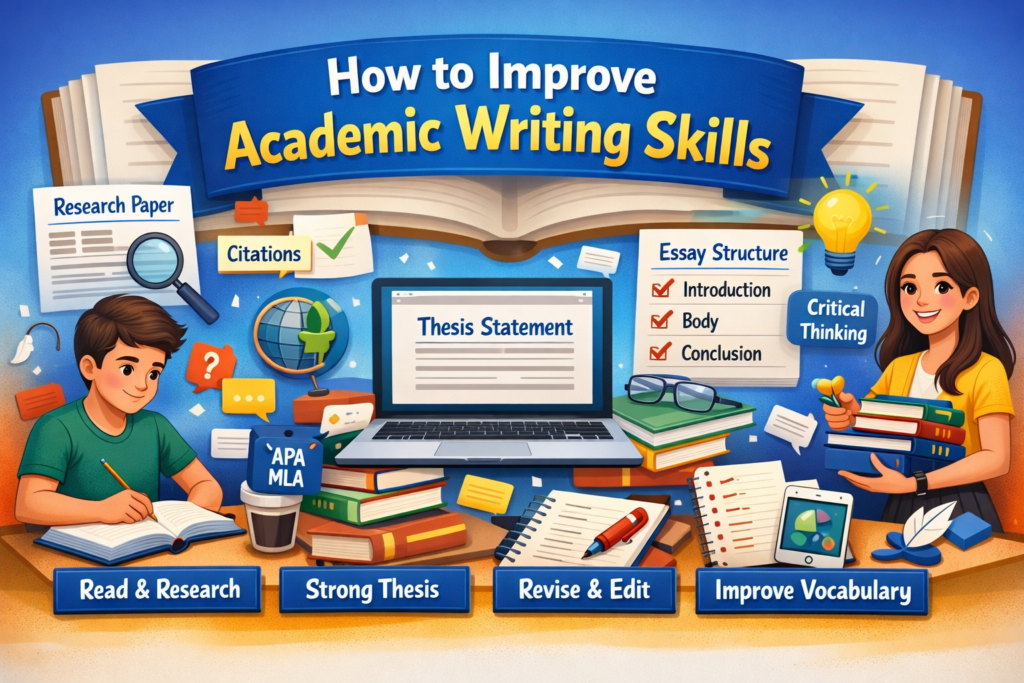
Introduction
Academic writing is one of the most important skills for students, researchers, and professionals. It’s not just about writing essays or reports — it’s about communicating ideas clearly, logically, and persuasively.
In 2026, strong academic writing skills are essential for success in higher education and professional fields. Whether you’re preparing a research paper, thesis, or article, mastering academic writing helps you express your thoughts effectively and earn credibility.
This guide will teach you how to improve academic writing skills, with practical tips, examples, and strategies to help you write confidently and professionally.
What Is Academic Writing?
Academic writing is a formal style of writing used in universities, research institutions, and scholarly publications. It focuses on clarity, evidence, and structure rather than emotion or opinion.
Key Features:
- Objective and evidence‑based
- Structured and organized
- Formal tone and vocabulary
- Proper citations and references
- Logical flow of ideas
Example: Instead of saying “I think pollution is bad,” academic writing would say, “Studies indicate that air pollution contributes to respiratory diseases (WHO, 2025).”
Why Academic Writing Skills Matter
Strong academic writing skills help you:
- Communicate complex ideas clearly
- Build credibility and professionalism
- Achieve higher grades and recognition
- Publish research successfully
- Contribute to academic discussions
Example: A well‑written research paper can influence policies, inspire innovation, and open career opportunities.
Steps to Improve Academic Writing Skills
Let’s explore practical steps to enhance your academic writing.
1. Understand the Purpose of Academic Writing
Before writing, know why you’re writing. Academic writing aims to inform, analyze, and argue based on evidence.
Tips:
- Identify your audience (professors, researchers, peers).
- Define your objective — to explain, compare, or persuade.
- Focus on facts, not opinions.
2. Read Academic Papers Regularly
Reading scholarly articles improves vocabulary, tone, and structure. Example: Journals like Nature, Harvard Business Review, or IEEE Transactions show how professionals write academically.
Tips:
- Analyze how arguments are presented.
- Note citation styles and transitions.
- Summarize key points in your own words.
3. Develop a Strong Vocabulary
Academic writing uses precise and formal language. Example: Replace “a lot of” with “numerous” or “significant.”
Tips:
- Learn academic phrases like “in contrast,” “as evidenced by,” “it can be inferred that.”
- Avoid slang and contractions.
- Use discipline‑specific terminology accurately.
4. Focus on Structure and Organization
A clear structure makes your writing easy to follow. Typical Format:
- Introduction
- Literature Review
- Methodology
- Results
- Discussion
- Conclusion
Tips:
- Use headings and subheadings.
- Maintain logical flow between paragraphs.
- Start each paragraph with a topic sentence.
5. Practice Critical Thinking
Academic writing is not about summarizing — it’s about analyzing. Example: Instead of repeating facts, evaluate their significance or limitations.
Tips:
- Ask questions like “Why?” and “How?”
- Compare different viewpoints.
- Support arguments with credible evidence.
6. Use Reliable Sources
Citations strengthen your arguments and prevent plagiarism. Tips:
- Use peer‑reviewed journals and academic databases.
- Follow citation styles (APA, MLA, Chicago).
- Include a reference list at the end.
7. Master Paraphrasing and Summarizing
Avoid copying directly — rewrite ideas in your own words. Example: Original: “Climate change affects agriculture.” Paraphrased: “Agricultural productivity is increasingly influenced by climate variations.”
Tips:
- Read, understand, and then rewrite.
- Keep the original meaning intact.
- Use quotation marks for direct quotes.
8. Improve Grammar and Sentence Structure
Grammar errors can weaken your credibility. Tips:
- Use tools like Grammarly or ProWritingAid.
- Avoid long, complex sentences.
- Maintain subject‑verb agreement and proper punctuation.
9. Practice Academic Writing Daily
Writing regularly builds confidence and fluency. Tips:
- Start with short essays or summaries.
- Review your work critically.
- Seek feedback from mentors or peers.
10. Edit and Proofread Thoroughly
Editing ensures clarity and accuracy. Tips:
- Check for grammar, spelling, and formatting errors.
- Read aloud to catch awkward phrasing.
- Use editing tools or professional proofreading services
Tools to Improve Academic Writing
| Tool | Purpose |
|---|---|
| Grammarly | Grammar and style correction |
| QuillBot | Paraphrasing and summarizing |
| Zotero | Reference management |
| Hemingway Editor | Simplifies complex sentences |
| Google Scholar | Finds credible academic sources |

