
Introduction
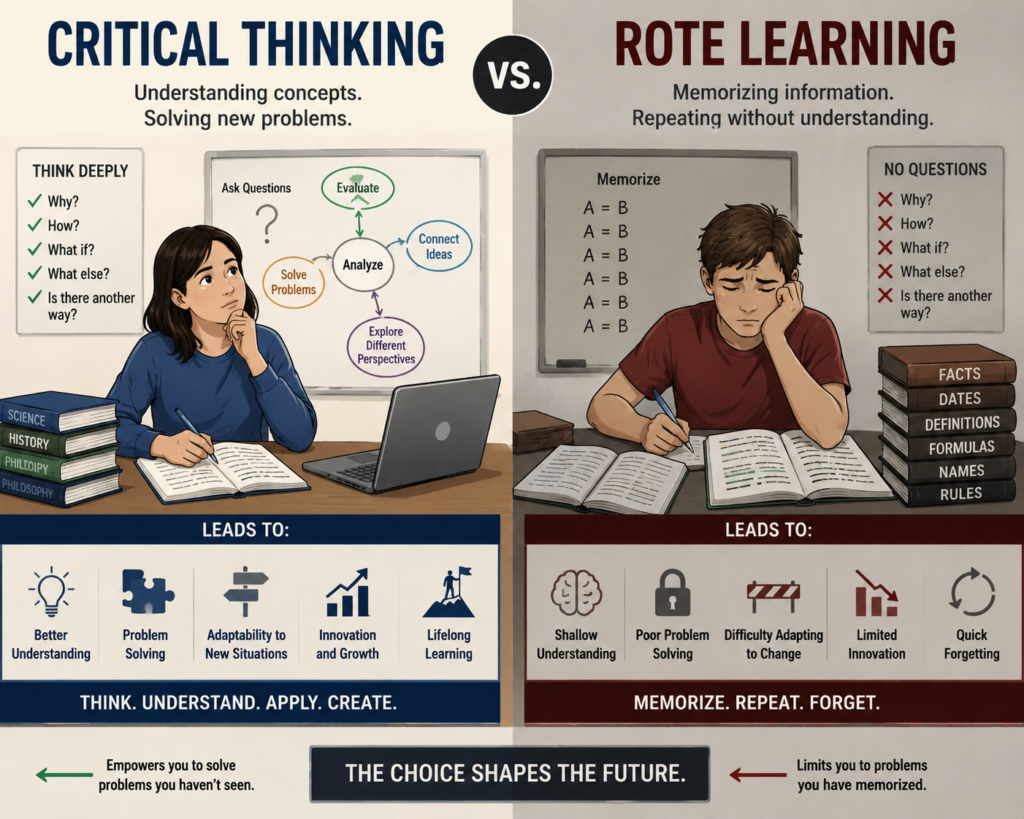
Education is not just about memorizing facts—it’s about understanding concepts and applying them in real life. While rote learning focuses on repetition and memorization, critical thinking emphasizes reasoning, problem‑solving, and creativity. Both methods have their place, but critical thinking is increasingly recognized as the key to academic and professional success.
What is Rote Learning?
- Definition: Learning by repetition without necessarily understanding the meaning.
- Examples: Memorizing multiplication tables, historical dates, or definitions.
- Advantages: Quick recall, useful for exams or short‑term memory tasks.
- Limitations: Lacks depth, discourages creativity, and knowledge is often forgotten
Comparison Table
| Aspect | Rote Learning | Critical Thinking |
|---|---|---|
| Approach | Memorization through repetition | Analysis, evaluation, reasoning |
| Retention | Short‑term | Long‑term, deeper understanding |
| Creativity | Limited | Encourages innovation |
| Application | Rarely applicable beyond exams | Useful in real‑life problem‑solving |
| Assessment | Good for factual recall | Better for essays, projects, debates |
Role in Education
- Rote learning in exams: Helps with quick recall but doesn’t build skills.
- Critical thinking in classrooms: Encourages discussions, debates, and project‑based learning.
- Paradigm shift: Modern education systems, including India’s NEP 2020, emphasize critical thinking and experiential learning.

