
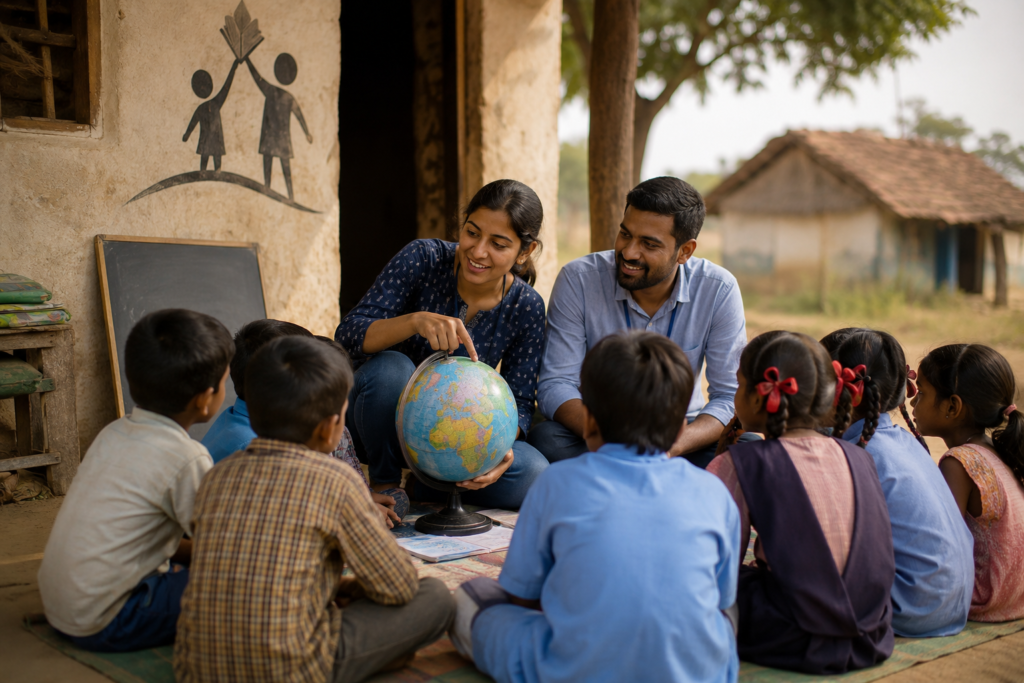
NGOs Supporting Rural Education in India
Introduction
India’s rural population makes up nearly 65% of the country, yet educational access remains uneven. Challenges include poor infrastructure, lack of trained teachers, high dropout rates, and socio-economic barriers. Here, NGOs supporting rural education step in to complement government efforts, ensuring inclusive and equitable learning opportunities.
Role of NGOs in Rural Education
- Access to schools: NGOs establish schools in remote villages.
- Teacher training: They improve teaching quality through workshops.
- Digital literacy: Smart classrooms and e-learning initiatives.
- Girls’ education: Programs like Nanhi Kali focus on retention of rural girls.
- Community engagement: Parents and local leaders are involved to sustain progress.
Leading NGOs in Rural Education
| NGO | Focus Area | Impact |
|---|---|---|
| Pratham | Literacy campaigns | Reached 50M+ children |
| eVidyaloka | Digital classrooms | Remote teaching in 20+ states |
| Azim Premji Foundation | Teacher training | Active in 200 districts |
| Smile Foundation | Holistic education | 200,000+ children supported |
| Teach For India | Volunteer teaching | Alumni impacting 33M children |
| Room to Read India | Literacy & gender equality | 870,000+ girls supported |
| Nanhi Kali | Girls’ education | 450,000+ girls enrolled |
Case Studies
- Pratham’s ASER Survey: Revealed literacy gaps and designed remedial programs.
- eVidyaloka: Uses volunteer teachers via digital platforms to reach villages.
- Azim Premji Foundation: Focuses on systemic teacher training and curriculum reform.
Challenges Faced by NGOs
- Funding limitations – Reliance on donations and CSR.
- Scaling issues – Expanding pilot projects nationwide.
- Cultural barriers – Tackling child labor and gender bias.
- Digital divide – Limited internet in rural schools.
Conclusion
NGOs are last-mile enablers in rural education. By combining grassroots innovation, digital tools, and community engagement, they ensure that rural children are not left behind. Their work is vital for India’s vision of Education for All.

