
Introduction
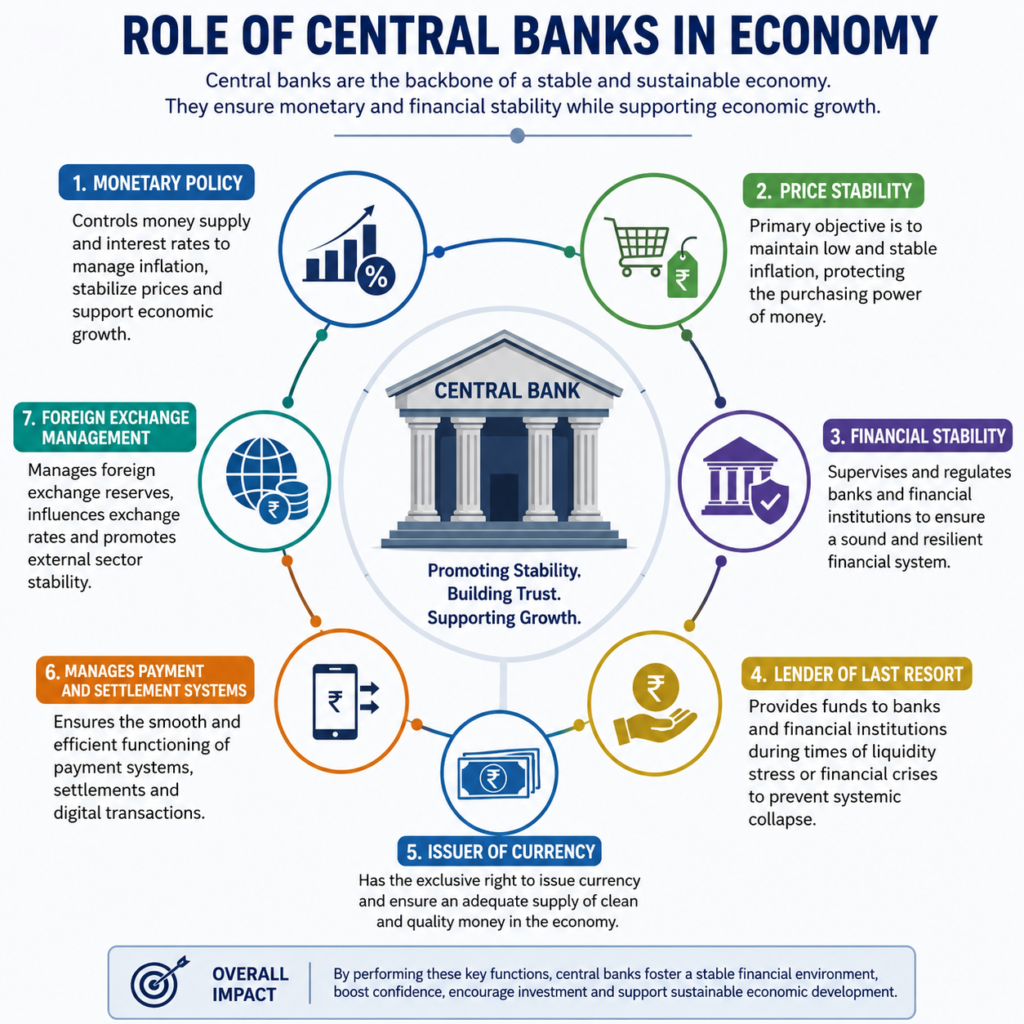
Central banks are the backbone of a nation’s financial system. They regulate money supply, control inflation, stabilize currency, and ensure economic growth. At Eduvish.com, we simplify this complex topic so that students, professionals, and curious minds can understand how central banks shape the economy and influence everyday life.
What Is a Central Bank?
A central bank is a national institution that manages a country’s currency, money supply, and interest rates. It acts as the guardian of financial stability, ensuring smooth functioning of the economy.
Examples include:
- Reserve Bank of India (RBI)
- Federal Reserve (USA)
- European Central Bank (ECB)
- Bank of England (UK)
Key Functions of Central Banks
| Function | Description |
|---|---|
| Monetary Policy | Controls money supply and interest rates to maintain economic stability. |
| Currency Issuance | Sole authority to print and distribute national currency. |
| Inflation Control | Uses interest rates and money supply to manage inflation. |
| Financial Supervision | Regulates banks and financial institutions. |
| Foreign Exchange Management | Maintains stability in exchange rates and foreign reserves. |
| Economic Growth Support | Promotes sustainable development through balanced policies. |
Role of Central Banks in Economic Stability
Central banks play a crucial role in maintaining economic balance. They ensure that inflation doesn’t rise uncontrollably and that growth doesn’t stagnate.
1. Controlling Inflation
By adjusting interest rates, central banks influence borrowing and spending.
- High inflation → Increase interest rates.
- Low inflation → Decrease interest rates.
2. Promoting Employment
Through monetary policies, central banks encourage investment and job creation.
3. Maintaining Currency Value
They stabilize the national currency against global fluctuations.
4. Ensuring Financial Stability
Central banks act as a lender of last resort during financial crises, providing liquidity to banks.
Tools of Monetary Policy
Central banks use several instruments to control the economy:
- Repo Rate – The rate at which banks borrow money from the central bank.
- Reverse Repo Rate – The rate at which banks deposit money with the central bank.
- Cash Reserve Ratio (CRR) – The percentage of deposits banks must keep with the central bank.
- Open Market Operations – Buying and selling government securities to regulate liquidity.
- Statutory Liquidity Ratio (SLR) – Ensures banks maintain a certain amount of liquid assets.
Central Banks and Economic Growth
Central banks influence growth by balancing inflation and investment.
- Low interest rates → Encourage borrowing and spending.
- High interest rates → Control inflation but may slow growth.
They also support government initiatives for infrastructure, education, and innovation through financial policies.
Central Banks During Economic Crises
During recessions or financial instability, central banks act swiftly to restore confidence.
- Lower interest rates to boost spending.
- Inject liquidity into markets.
- Support struggling financial institutions.
Example: During the COVID‑19 pandemic, central banks worldwide reduced interest rates and launched stimulus packages to revive economies.
Global Role of Central Banks
In the global economy, central banks coordinate policies to maintain financial harmony.
- International Monetary Cooperation – Collaborate through institutions like the IMF.
- Exchange Rate Stability – Prevent excessive currency fluctuations.
- Cross‑border Banking Regulation – Ensure safe international transactions.
Challenges Faced by Central Banks
- Balancing inflation and growth.
- Managing global economic shocks.
- Adapting to digital currencies and fintech innovations.
- Maintaining independence from political influence.
Future of Central Banking
The future will see central banks embracing digital transformation.
- Central Bank Digital Currencies (CBDCs) will revolutionize payments.
- AI and data analytics will enhance policy decisions.
- Global collaboration will strengthen financial resilience.

