
Introduction
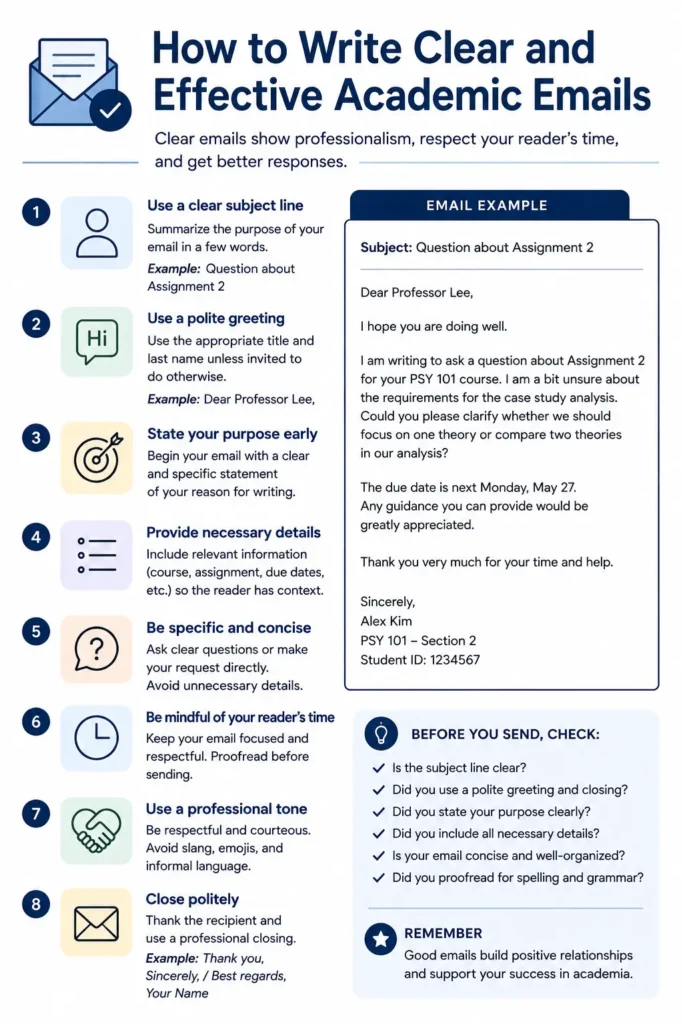
How to write clear and effective academic emails is an important skill for students, researchers, and professionals. Academic emails help communicate with professors, supervisors, institutions, and colleagues in a professional manner. Understanding how to write clear and effective academic emails can improve communication, build credibility, and increase the chances of receiving timely responses.
1. Understanding Academic Emails
Academic emails are formal messages used for educational or research purposes. They reflect your professionalism and communication skills.
Why It Matters:
- Builds credibility and respect.
- Helps you communicate effectively with professors and peers.
- Creates opportunities for collaboration and academic success.
SEO Keywords: academic email writing tips, how to write professional emails, email etiquette for students
2. Know Your Purpose
Before writing, identify the reason for your email.
Common Purposes:
- Asking for clarification on assignments.
- Requesting recommendations or feedback.
- Applying for internships or research positions.
- Scheduling meetings or appointments.
Tip: Keep your message focused on one clear purpose.
3. Use a Professional Email Address
Your email address should reflect your identity professionally.
Examples: ✅ priyanshi.sharma@university.edu ❌ cutegirl123@gmail.com
Result: A professional email address builds trust and credibility.
4. Write a Clear Subject Line
The subject line is the first thing your recipient sees. It should summarize your message in a few words.
Examples:
- “Request for Meeting Regarding Research Proposal”
- “Clarification on Assignment Submission Deadline”
- “Application for Internship Opportunity”
SEO Keywords: academic email subject line examples, effective email writing for students
5. Start with a Proper Greeting
Always begin your email with a polite greeting.
Examples:
- “Dear Professor Sharma,”
- “Hello Dr. Mehta,”
- “Good morning, Ms. Patel,”
Avoid casual greetings like “Hey” or “Hi there” in academic emails.
6. Introduce Yourself Briefly
If the recipient doesn’t know you, introduce yourself in one or two sentences.
Example: “I am Priyanshi Sharma, a second-year student in the Department of Psychology at EduVish University.”
This helps the recipient understand your background and context.
7. State Your Purpose Clearly
Get straight to the point without unnecessary details.
Example: “I am writing to request feedback on my research proposal submitted last week.”
Tip: Avoid long paragraphs—keep your message concise and focused.
8. Use Polite and Formal Language
Academic emails should be respectful and professional.
Examples: ✅ “Could you please clarify…” ✅ “I would appreciate your guidance…” ❌ “Hey, can you tell me…”
SEO Keywords: formal email writing tips, academic communication skills
9. Organize Your Email Structure
A well-structured email is easy to read and understand.
Structure Example:
- Greeting
- Introduction
- Purpose of the email
- Supporting details or questions
- Closing statement
Result: Your email looks professional and organized.
10. Be Specific and Direct
Avoid vague statements. Be clear about what you need.
Example: Instead of “I need help,” write “I need clarification on the data analysis section of my report.”
SEO Keywords: clear communication in emails, academic writing clarity
11. Maintain a Respectful Tone
Respectful communication builds positive relationships.
Tips:
- Avoid demanding language.
- Use “please” and “thank you.”
- Be patient when waiting for replies.
Result: You’ll be seen as polite and professional.
12. Avoid Grammar and Spelling Mistakes
Errors can make your email look careless.
Tips:
- Proofread before sending.
- Use tools like Grammarly or spell check.
- Read your email aloud to catch mistakes.
SEO Keywords: grammar tips for academic emails, proofreading techniques for students
13. Use a Professional Closing
End your email with a polite closing line and signature.
Examples:
- “Thank you for your time and consideration.”
- “Looking forward to your response.”
Closings:
- “Best regards,”
- “Sincerely,”
- “Yours faithfully,”
Signature Example: Priyanshi Sharma Department of Psychology EduVish University
14. Follow-Up Politely
If you don’t receive a reply within a few days, send a polite follow-up.
Example: “Dear Professor Sharma, I hope you are doing well. I wanted to kindly follow up on my previous email regarding the research proposal feedback.”
Tip: Wait at least 3–5 business days before following up.
15. Avoid Common Mistakes
Mistakes to Avoid:
- Writing overly long emails.
- Using slang or emojis.
- Forgetting attachments.
- Sending without proofreading.
Result: Avoiding these mistakes ensures professionalism and clarity.
16. Attach Files Properly
If you’re sending documents, mention them in the email body.
Example: “I have attached my research proposal for your review.”
Tip: Name files clearly, e.g., “Priyanshi_Sharma_ResearchProposal.pdf.”
17. Be Mindful of Timing
Send emails during working hours (9 AM–5 PM). Avoid late-night or weekend messages unless urgent.
Result: Shows respect for the recipient’s time.
18. Use Formatting Wisely
Keep your email clean and readable.
Tips:
- Use short paragraphs.
- Avoid excessive bold or italics.
- Use bullet points for clarity.
SEO Keywords: email formatting tips, academic email structure
19. Show Gratitude
Always thank the recipient for their time and help.
Example: “Thank you for your guidance and support throughout the project.”
Gratitude leaves a positive impression.
20. Practice Makes Perfect
The more you write academic emails, the better you’ll get.
Tips:
- Review examples from your professors.
- Keep a template for common requests.
- Reflect on feedback to improve your tone and clarity.
Conclusion
Writing clear and effective academic emails is a skill that can open doors to opportunities and strengthen professional relationships. By following these guidelines—being polite, concise, and organized—you can communicate confidently and make a positive impression in your academic journey.
Remember, every email you send represents your professionalism and respect for others.

