
Introduction
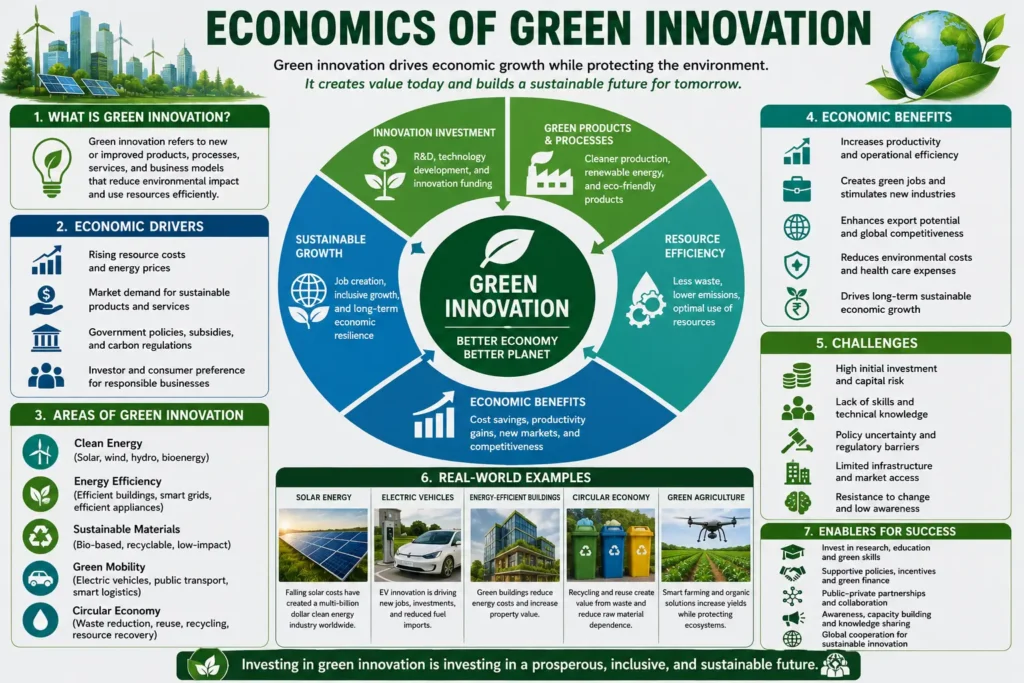
In today’s world, green innovation is more than a buzzword — it is a necessity. As climate change, pollution, and resource depletion threaten global stability, economies are shifting toward sustainable technologies. The economics of green innovation explores how eco‑friendly solutions impact growth, investment, employment, and competitiveness.
This article for Eduvish.com provides a comprehensive, SEO‑friendly analysis of green innovation, its economic benefits, challenges, and future prospects.
What Is Green Innovation?
Green innovation refers to the development of products, services, and processes that reduce environmental impact while promoting economic growth.
Key Features
- Eco‑friendly technologies: Renewable energy, electric vehicles, biodegradable materials.
- Resource efficiency: Reducing waste and maximizing productivity.
- Sustainable business models: Circular economy, recycling, and reuse.
- Policy support: Subsidies, tax incentives, and regulations.
Economic Benefits of Green Innovation
Green innovation is not just good for the planet — it is profitable.
1. Job Creation
- Renewable energy industries create millions of jobs worldwide.
- Green construction and sustainable agriculture boost employment.
2. Economic Growth
- Green technologies attract investment and open new markets.
- Countries leading in innovation gain competitive advantage.
3. Cost Savings
- Energy efficiency reduces operational costs.
- Waste reduction saves resources and improves profitability.
4. Global Trade Opportunities
- Export of green technologies strengthens international trade.
- Nations with advanced green industries dominate global markets.
Green Innovation and Sustainable Development
Green innovation directly supports the UN Sustainable Development Goals:
- Goal 7: Affordable and clean energy.
- Goal 9: Industry, innovation, and infrastructure.
- Goal 12: Responsible consumption and production.
- Goal 13: Climate action.
Role of Politics and Policy
Politics plays a crucial role in shaping the economics of green innovation.
Examples
- Carbon pricing encourages businesses to reduce emissions.
- Government subsidies make renewable energy affordable.
- International agreements like the Paris Accord push nations toward sustainability.
Challenges in Green Innovation Economics
Despite its benefits, green innovation faces hurdles:
- High initial investment in technology.
- Resistance from traditional industries like coal and oil.
- Policy uncertainty in developing nations.
- Global inequality in access to green technologies.
Case Studies
1. Germany’s Energiewende
A political and economic push toward renewable energy transformed Germany’s economy.
2. China’s Green Manufacturing
Massive investment in solar panels and electric vehicles made China a global leader.
3. India’s Solar Mission
Affordable solar energy projects boosted rural electrification and job creation.
Future of Green Innovation
The future lies in digital transformation and sustainability.
Emerging Trends
- AI in green innovation for smart energy management.
- Circular economy reducing waste.
- Green finance supporting eco‑friendly startups.
- Global cooperation for shared technology and investment.
Conclusion
The economics of green innovation shows that sustainability and profitability can go hand in hand. By investing in eco‑friendly technologies, nations can achieve growth, create jobs, and protect the environment.
Green innovation is not just the future of economics — it is the future of humanity.