
Introduction
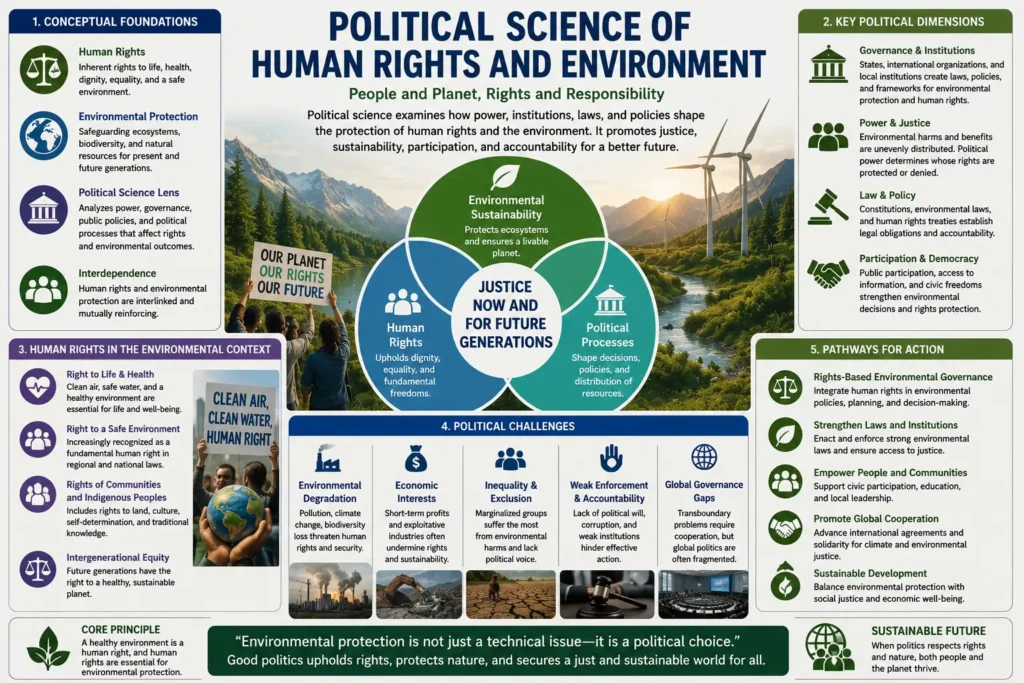
The intersection of political science, human rights, and environment is one of the most important areas of modern governance. It examines how political institutions, legal frameworks, and international agreements protect both people and nature.
Human Rights and Environment
- Right to a healthy environment: Recognized globally by the UN Human Rights Council (2021) and UN General Assembly (2022).
- India’s Article 21: Interpreted by the Supreme Court to include the right to a clean environment.
- Judicial activism: Landmark cases like M.C. Mehta vs. Union of India expanded environmental rights.
Political Science Dimensions
- Constitutional law: Articles 21, 48A, and 51A(g) in India link environment with fundamental duties and rights.
- International agreements: Stockholm Declaration (1972), Rio Declaration (1992), Paris Agreement (2015).
- Institutions: National Green Tribunal (NGT), CPCBs, SPCBs ensure enforcement.
Sustainable Development and Rights
- Environmental justice is now seen as part of social justice.
- Protecting ecosystems ensures intergenerational equity.
- Political science emphasizes participatory governance and community rights in environmental decision‑making.
Challenges
- Weak enforcement of laws.
- Policy incoherence between development and environment.
- Corruption and extractive policies undermining sustainability.
- Climate change intensifying rights violations.
Conclusion
The political science of human rights and environment shows that protecting nature is inseparable from protecting people. Strong institutions, global cooperation, and rights‑based governance are essential for sustainable development.

