
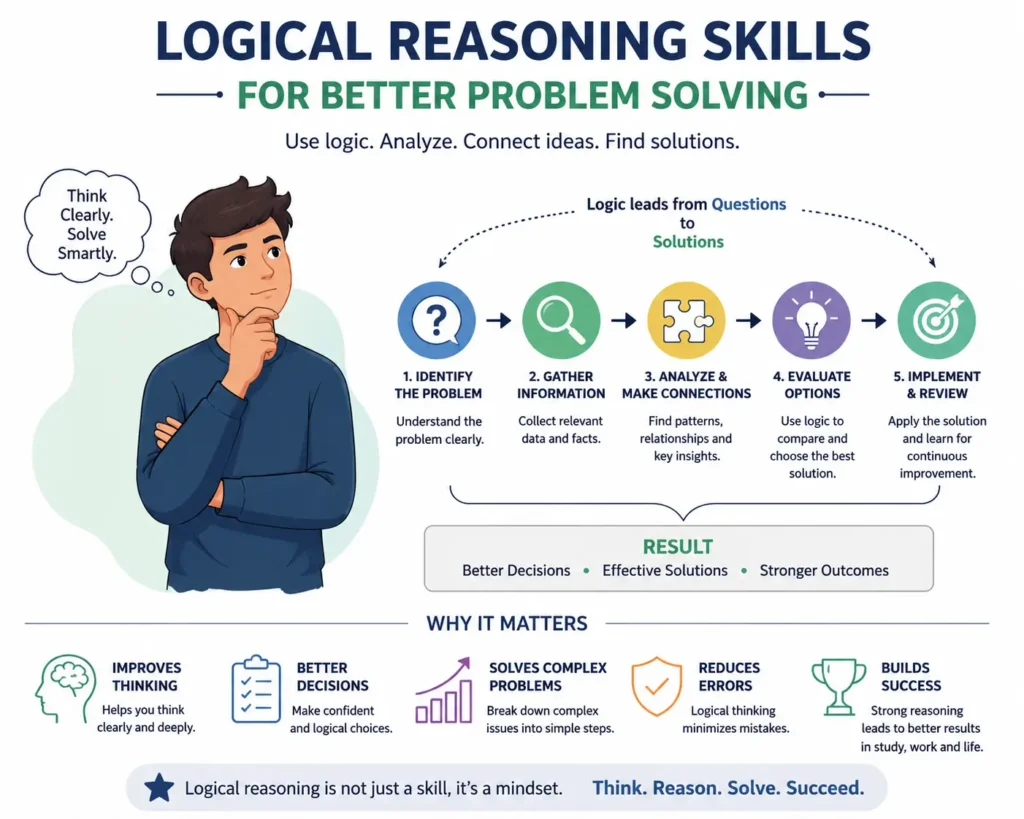
What is Logical Reasoning?
Logical reasoning is the ability to analyze information, identify patterns, and draw sound conclusions. Unlike emotional or impulsive decisions, logical reasoning relies on facts, evidence, and structured thinking.
Key Benefits:
- Improved decision-making: Avoids biases and errors.
- Enhanced problem-solving: Breaks down complex issues into manageable steps.
- Clearer communication: Helps present arguments coherently.
- Better learning: Supports systematic understanding of new concepts.
Core Logical Reasoning Techniques
| Technique | How It Works | Best Use Case |
|---|---|---|
| Deductive Reasoning | Apply general rules to specific cases. | Solving structured problems. |
| Inductive Reasoning | Derive general principles from specific observations. | Research, forecasting. |
| Analytical Reading | Critically evaluate texts for arguments and evidence. | Academic study, professional reports. |
| 5 Whys Analysis | Ask “Why?” repeatedly to uncover root causes. | Operational problem-solving. |
| Logic Puzzles | Train the brain with structured challenges. | Daily practice to sharpen reasoning. |
How Logical Reasoning Improves Problem Solving
- Breaks down problems into smaller, solvable parts.
- Identifies root causes rather than treating symptoms.
- Encourages creativity by combining structured logic with brainstorming.
- Supports collaboration by making arguments clear and evidence-based.
Challenges and Mistakes to Avoid
- Over-relying on intuition without evidence.
- Ignoring emotional influences (studies show mood affects reasoning performance).
- Failing to practice regularly with puzzles or analytical reading.
Best Practices for Students & Professionals
- Practice logic puzzles like Sudoku or chess daily.
- Engage in analytical reading of complex texts.
- Learn formal logic principles (syllogisms, fallacies).
- Apply reasoning frameworks like Root Cause Analysis in real-world problems.
- Balance logic with emotional intelligence for holistic decision-making.
Conclusion
Logical reasoning is a critical skill for problem-solving in 2026. By mastering deductive and inductive reasoning, analytical reading, and structured frameworks, students and professionals can make better decisions, solve problems effectively, and communicate with clarity.