
Introduction
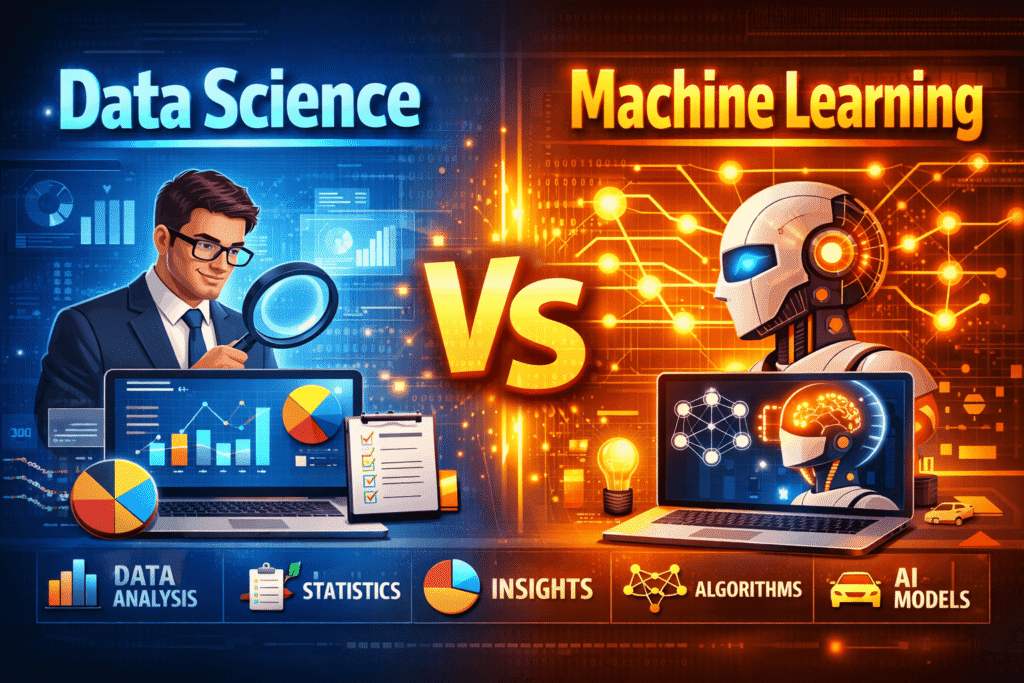
Data Science vs Machine Learning is one of the most common comparisons in the technology industry. While both fields work with data and advanced analytics, they differ in objectives, tools, skills, and career opportunities. Understanding Data Science vs Machine Learning can help students and professionals choose the right learning path and career direction in the rapidly growing field of technology..
Understanding Data Science
- Definition: Data Science is the study of data — collecting, analyzing, and interpreting it to extract meaningful insights.
- Goal: To help organizations make informed decisions using data‑driven evidence.
- Core components: Statistics, data analysis, visualization, and predictive modeling.
- Tools used: Python, R, SQL, Tableau, Power BI, and Hadoop.
Understanding Machine Learning
- Definition: Machine Learning is a subset of Artificial Intelligence (AI) that enables computers to learn from data without explicit programming.
- Goal: To create algorithms that improve automatically through experience.
- Core components: Algorithms, training data, model evaluation, and optimization.
- Tools used: TensorFlow, Scikit‑learn, PyTorch, Keras, and MATLAB.
Key Differences Between Data Science and Machine Learning
| Aspect | Data Science | Machine Learning |
|---|---|---|
| Definition | Broad field focused on data analysis and insights | Subfield of AI focused on learning from data |
| Objective | Extract insights and patterns | Build predictive models |
| Techniques | Statistics, visualization, data mining | Algorithms, neural networks, deep learning |
| Output | Reports, dashboards, recommendations | Trained models and predictions |
| Tools | Python, R, SQL, Tableau | TensorFlow, PyTorch, Scikit‑learn |
| Applications | Business analytics, healthcare, finance | Speech recognition, recommendation systems, autonomous vehicles |
How Data Science and Machine Learning Work Together
Data Science and Machine Learning are interconnected disciplines.
- Data preparation: Data scientists clean and structure data for ML models.
- Model building: ML engineers create algorithms to analyze patterns.
- Insight generation: Data scientists interpret model results to guide decisions. Together, they form the backbone of AI‑powered analytics.
Applications in Real‑World Industries
a. Healthcare
Predicting diseases, analyzing medical images, and optimizing treatment plans.
b. Finance
Fraud detection, credit scoring, and algorithmic trading.
c. Retail
Customer segmentation, demand forecasting, and recommendation systems.
d. Education
Personalized learning experiences and student performance analytics.
e. Manufacturing
Predictive maintenance and process optimization.
Skills Required
| Skill Category | Data Science | Machine Learning |
|---|---|---|
| Programming | Python, R, SQL | Python, C++, Java |
| Mathematics | Statistics, probability | Linear algebra, calculus |
| Visualization | Tableau, Power BI | Matplotlib, Seaborn |
| Data Handling | Pandas, NumPy | TensorFlow, Keras |
| Domain Knowledge | Business analytics | Algorithm design |
Career Opportunities
Data Science Roles
- Data Analyst
- Data Engineer
- Business Intelligence Analyst
- Data Scientist
Machine Learning Roles
- Machine Learning Engineer
- AI Researcher
- Deep Learning Specialist
- Computer Vision Engineer
Salary Comparison
| Role | Average Annual Salary (India) |
|---|---|
| Data Scientist | ₹10–15 Lakh |
| Machine Learning Engineer | ₹12–18 Lakh |
| Data Analyst | ₹6–9 Lakh |
| AI Researcher | ₹15–25 Lakh |
Future Trends
- AI integration: Data Science and ML will merge further with AI for smarter automation.
- Cloud computing: Platforms like AWS and Azure will dominate data processing.
- Edge analytics: Real‑time data analysis at the source.
- Ethical AI: Focus on transparency and fairness in algorithms.
Which One Should You Choose?
If you love analyzing data and storytelling through insights, choose Data Science. If you enjoy building intelligent systems and coding algorithms, go for Machine Learning. Both fields offer high demand, lucrative salaries, and endless growth opportunities.
Conclusion
Data Science and Machine Learning are two sides of the same coin — one focuses on understanding data, the other on learning from it. Together, they drive innovation across industries and shape the future of technology. Whether you choose Data Science or Machine Learning, you’ll be part of a field that’s transforming the world.