
Introduction
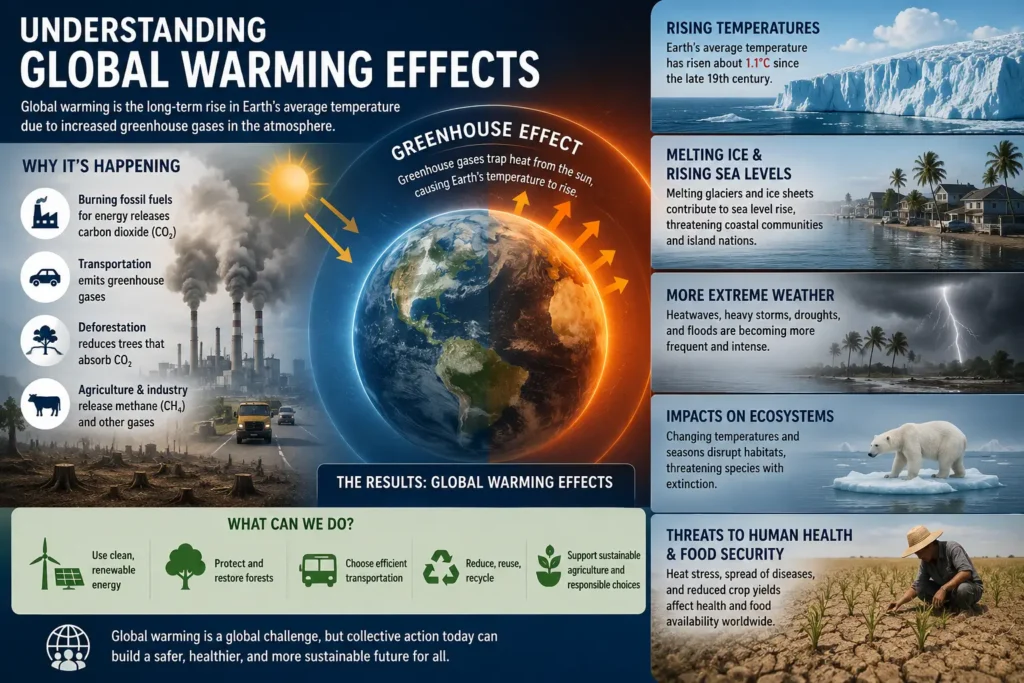
Global warming is one of the most pressing challenges of our time. It refers to the gradual increase in Earth’s average temperature due to the accumulation of greenhouse gases like carbon dioxide, methane, and nitrous oxide. This warming has far‑reaching consequences for the planet’s climate, ecosystems, and human life.
Understanding the effects of global warming is essential to take action toward a sustainable future.
What Is Global Warming?
Global warming is the long‑term heating of Earth’s climate system caused by human activities, primarily the burning of fossil fuels.
Key Causes
- Greenhouse gas emissions from industries and vehicles.
- Deforestation reducing carbon absorption.
- Agricultural practices releasing methane.
- Industrial pollution increasing atmospheric toxins.
How Global Warming Works
The greenhouse effect traps heat in Earth’s atmosphere. While this process is natural, human activities have intensified it.
Process Overview
- Sunlight reaches Earth’s surface.
- The planet absorbs and radiates heat.
- Greenhouse gases trap this heat, preventing it from escaping.
- Excess gases cause temperature rise.
Major Effects of Global Warming
Global warming affects every aspect of life — from weather patterns to food security.
1. Climate Change
Rising temperatures lead to unpredictable weather, droughts, floods, and storms.
2. Melting Glaciers and Ice Caps
Polar regions are warming faster, causing glaciers to melt and sea levels to rise.
3. Rising Sea Levels
Coastal cities face flooding and erosion, threatening millions of lives.
4. Extreme Weather Events
Heatwaves, hurricanes, and wildfires are becoming more frequent and intense.
5. Loss of Biodiversity
Species unable to adapt to changing climates face extinction.
6. Impact on Agriculture
Crop yields decline due to irregular rainfall and soil degradation.
7. Human Health Risks
Heat stress, respiratory diseases, and vector‑borne illnesses are increasing.
Global Warming and Oceans
Oceans absorb much of the excess heat and carbon dioxide, leading to ocean acidification and coral bleaching.
Consequences
- Marine species migration.
- Decline in fish populations.
- Disruption of coastal ecosystems.
Global Warming and Polar Regions
The Arctic and Antarctic are warming twice as fast as the global average.
Effects
- Shrinking ice sheets.
- Habitat loss for polar bears and penguins.
- Changes in ocean currents affecting global weather.
Economic Impact of Global Warming
Global warming has serious economic consequences.
Key Impacts
- Infrastructure damage from floods and storms.
- Reduced agricultural productivity.
- Increased healthcare costs.
- Energy demand rise for cooling systems.
Global Warming and Human Migration
Climate change forces people to move from affected areas.
Examples
- Coastal communities relocating due to rising seas.
- Farmers migrating after crop failures.
- Increased urban population pressure.
Solutions to Global Warming
While global warming is a major challenge, solutions exist to mitigate its effects.
1. Renewable Energy
Switching to solar, wind, and hydro power reduces carbon emissions.
2. Afforestation
Planting trees absorbs carbon dioxide and restores ecosystems.
3. Energy Efficiency
Using efficient appliances and vehicles lowers energy consumption.
4. Sustainable Agriculture
Eco‑friendly farming reduces methane and soil degradation.
5. Waste Management
Recycling and composting minimize landfill emissions.
6. International Cooperation
Global agreements like the Paris Accord aim to limit temperature rise.
Role of Individuals in Combating Global Warming
Every person can contribute to reducing global warming.
Simple Actions
- Use public transport or carpool.
- Reduce electricity consumption.
- Avoid single‑use plastics.
- Support eco‑friendly brands.
- Spread awareness about climate change.
Global Efforts and Policies
Organizations and governments worldwide are working to combat global warming.
Key Initiatives
- UN Climate Change Conference (COP)
- Paris Agreement
- IPCC Reports guiding global action.
The Future of Global Warming
If current trends continue, global temperatures could rise by 1.5°C to 2°C by 2050.
Possible Outcomes
- More frequent natural disasters.
- Food and water scarcity.
- Mass extinction of species.
- Economic instability.
However, with collective action, renewable energy adoption, and sustainable living, we can slow down global warming and protect our planet.
Conclusion
Global warming is not a distant threat — it’s happening now. Its effects are visible in melting glaciers, rising seas, and extreme weather events.
By understanding its causes and consequences, we can take meaningful steps toward a sustainable future. The time to act is now — for ourselves and for generations to come.