
Introduction
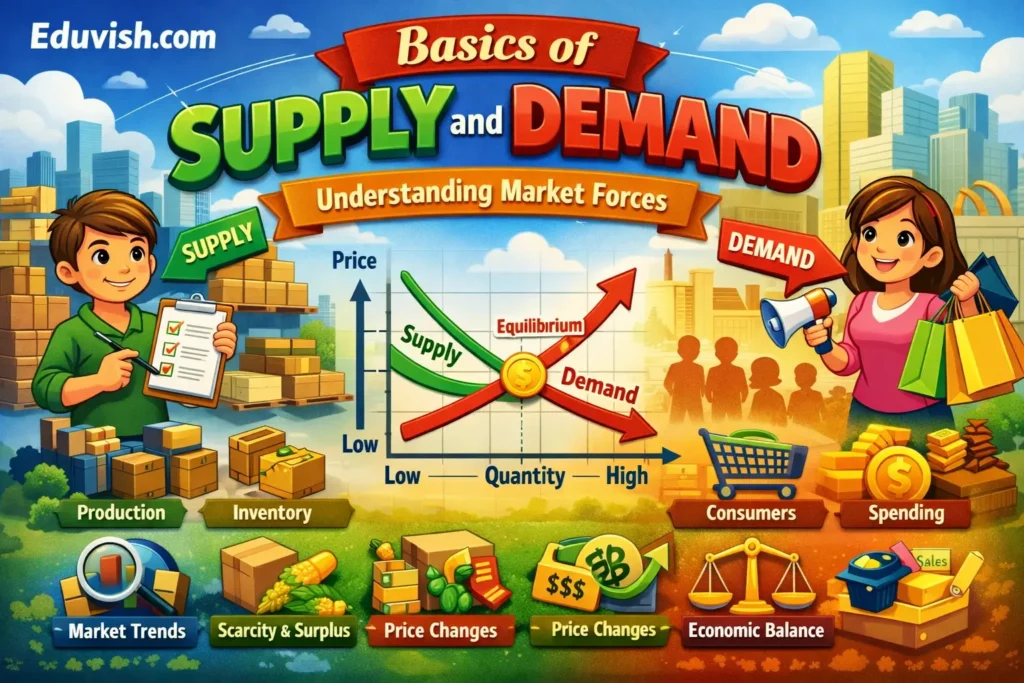
Supply and demand are the foundation of economics. They explain how prices are set, how markets function, and how resources are allocated. At Eduvish.com, we simplify these concepts so that students, entrepreneurs, and curious learners can understand how market forces shape everyday life.
What Is Supply and Demand?
- Supply – The quantity of goods or services producers are willing to sell at different prices.
- Demand – The quantity of goods or services consumers are willing to buy at different prices.
Together, supply and demand determine the market equilibrium — the point where the quantity supplied equals the quantity demanded.
The Law of Demand
- When prices rise, demand falls.
- When prices fall, demand rises. This inverse relationship is shown by a downward-sloping demand curve.
The Law of Supply
- When prices rise, supply increases.
- When prices fall, supply decreases. This direct relationship is shown by an upward-sloping supply curve.
Market Equilibrium
The intersection of the supply and demand curves is called equilibrium.
- At equilibrium, there is no shortage or surplus.
- Prices remain stable, and resources are efficiently allocated.
Factors Affecting Demand
- Income levels
- Consumer preferences
- Price of substitutes
- Price of complements
- Expectations
Factors Affecting Supply
- Production costs
- Technology
- Government policies
- Natural conditions
Real-Life Examples
- Housing market – Prices rise when demand exceeds supply.
- Agriculture – Weather impacts supply, affecting food prices.
- Technology products – High demand for smartphones increases prices.

