
Introduction
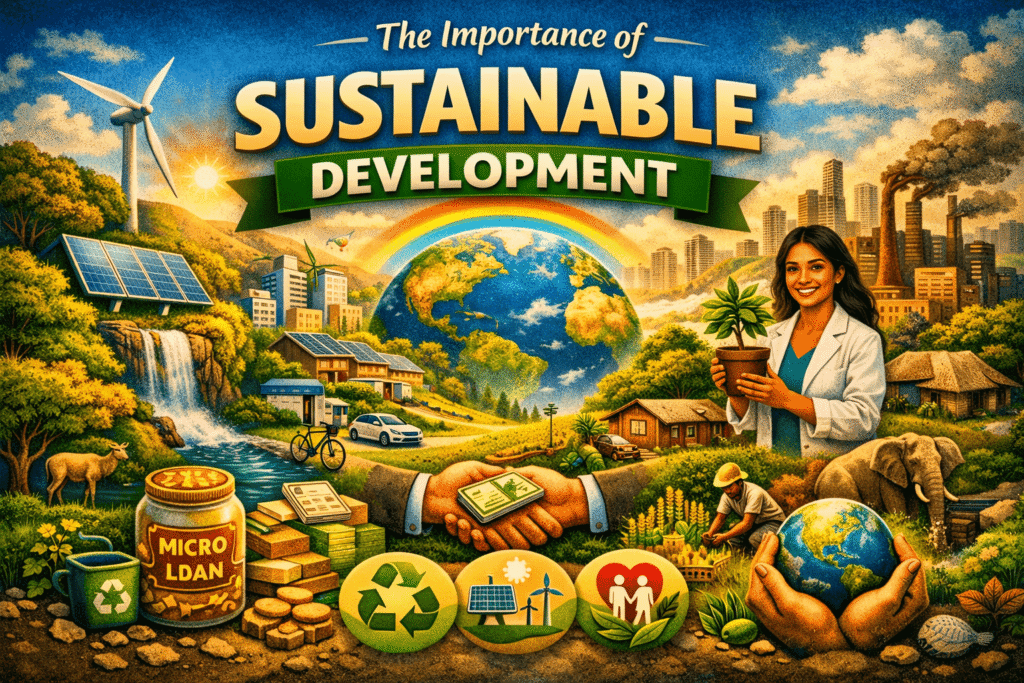
The world today faces challenges like climate change, pollution, deforestation, and resource depletion. To ensure a better future for generations to come, we must focus on sustainable development — a model that balances economic growth, social inclusion, and environmental protection.
Sustainable development is not just a concept; it’s a necessity. It ensures that progress today does not compromise the ability of future generations to meet their needs.
What Is Sustainable Development?
Sustainable development means using resources responsibly to achieve long‑term growth without harming the environment. It integrates three key pillars:
- Economic growth
- Social equity
- Environmental protection
Definition
The United Nations defines sustainable development as “development that meets the needs of the present without compromising the ability of future generations to meet their own needs.”
Why Sustainable Development Matters
Sustainable development is crucial for maintaining balance between human progress and nature.
Key Reasons
- Resource conservation: Prevents overuse of natural resources.
- Climate action: Reduces carbon emissions and global warming.
- Economic stability: Promotes long‑term growth.
- Social well‑being: Ensures equality and justice.
- Environmental protection: Safeguards biodiversity and ecosystems.
Pillars of Sustainable Development
| Pillar | Focus Area | Examples |
|---|---|---|
| Economic | Growth that benefits all | Green jobs, fair trade |
| Social | Equality and inclusion | Education, healthcare |
| Environmental | Protecting nature | Renewable energy, recycling |
Sustainable Development Goals (SDGs)
In 2015, the United Nations introduced 17 Sustainable Development Goals (SDGs) to achieve global prosperity and sustainability by 2030.
Major Goals
- No Poverty
- Zero Hunger
- Quality Education
- Gender Equality
- Clean Water and Sanitation
- Affordable and Clean Energy
- Climate Action
- Life on Land
- Partnerships for the Goals
Role of Sustainable Development in Everyday Life
Sustainability starts with small actions.
Examples
- Using renewable energy like solar and wind.
- Reducing plastic waste and promoting recycling.
- Supporting local and ethical businesses.
- Conserving water and electricity.
- Planting trees and protecting green spaces.
Economic Benefits of Sustainable Development
Sustainability is not just good for the planet — it’s good for business.
Advantages
- Green economy creates jobs.
- Energy efficiency reduces costs.
- Sustainable agriculture improves productivity.
- Eco‑tourism boosts local economies.
Environmental Benefits
Sustainable development helps preserve the planet’s natural systems.
Key Impacts
- Reduces pollution and waste.
- Protects forests and wildlife.
- Promotes renewable energy.
- Encourages sustainable urban planning.
Social Benefits
Sustainability ensures fairness and equality.
Positive Outcomes
- Better education and healthcare.
- Gender equality and empowerment.
- Reduced poverty and hunger.
- Stronger communities and social justice.
Challenges in Achieving Sustainable Development
Despite progress, several obstacles remain:
- Overpopulation
- Industrial pollution
- Deforestation
- Lack of awareness
- Economic inequality
Governments, businesses, and individuals must work together to overcome these challenges.
Role of Technology in Sustainable Development
Technology is a key driver of sustainability.
Innovations
- Renewable energy technology
- Smart cities
- Electric vehicles
- Waste management systems
- Artificial intelligence for resource optimization.
Global Examples of Sustainable Development
| Country | Initiative | Impact |
|---|---|---|
| Sweden | Renewable energy transition | 60% energy from renewables |
| Costa Rica | Forest conservation | Carbon‑neutral goal |
| Germany | Green technology | Leader in solar power |
| India | Clean energy mission | Expanding solar capacity |
| Japan | Waste recycling programs | High recycling rate |
The Future of Sustainable Development
The future depends on collective action. Governments, corporations, and individuals must adopt eco‑friendly policies, green technologies, and responsible consumption.
Emerging trends include:
- Circular economy
- Carbon neutrality
- Green finance
- Sustainable urbanization
Conclusion
Sustainable development is the foundation of a better future. It ensures that economic progress goes hand‑in‑hand with environmental care and social justice.
By embracing sustainability, we can create a world that is prosperous, equitable, and environmentally secure — a world where growth never comes at the cost of nature.