
Introduction
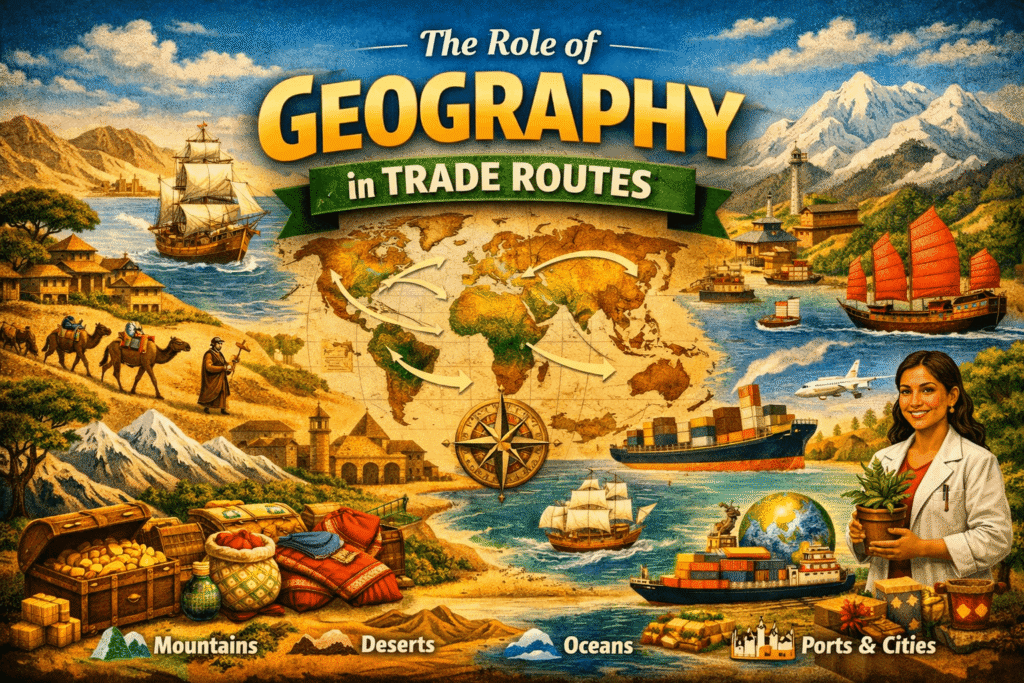
Trade has been the lifeline of civilizations for thousands of years. From the Silk Road to modern shipping lanes, geography has always shaped how goods, people, and ideas move across the world. Mountains, rivers, deserts, and oceans have influenced the formation of trade routes, determining where cities flourish and economies thrive.
Understanding the role of geography in trade routes helps us see how natural landscapes have guided global commerce and cultural exchange throughout history.
What Are Trade Routes?
Trade routes are pathways used for the exchange of goods and services between regions. They can be land routes, sea routes, or air routes, depending on the geographical features of the area.
Types of Trade Routes
| Type | Description | Examples |
|---|---|---|
| Land routes | Roads and trails across continents. | Silk Road, Grand Trunk Road |
| Sea routes | Maritime paths connecting ports. | Spice Route, Indian Ocean trade |
| River routes | Navigable rivers used for transport. | Nile, Ganges, Yangtze |
| Air routes | Modern aerial trade networks. | Global cargo flights |
How Geography Shapes Trade Routes
Geography determines accessibility, cost, and safety of trade routes.
Key Geographical Factors
- Mountains: Act as barriers but also create passes for trade.
- Rivers: Provide natural highways for goods.
- Deserts: Challenge traders but connect distant regions.
- Oceans: Enable large‑scale maritime trade.
- Climate: Influences navigation and transport efficiency.
Historical Examples of Geography Influencing Trade
1. The Silk Road
The Silk Road connected China to Europe through Central Asia. Geography played a vital role — traders crossed deserts like the Taklamakan and mountains like the Himalayas. It became a hub for exchanging silk, spices, and culture.
2. The Spice Route
The Spice Route linked Asia, Africa, and Europe via the Indian Ocean. Favorable monsoon winds helped ships travel efficiently, making coastal geography crucial for trade.
3. The Trans‑Saharan Route
This route connected North Africa to sub‑Saharan Africa through the Sahara Desert. Caravans of camels carried gold, salt, and ivory, guided by oases and sand dunes.
4. The Grand Trunk Road
Stretching from Bangladesh to Pakistan, this ancient route followed river valleys and plains, enabling trade across South Asia.
Modern Geography and Global Trade
Today, geography still influences trade through ports, canals, and air routes.
Key Examples
- Suez Canal: Connects the Mediterranean Sea to the Red Sea, shortening Europe‑Asia routes.
- Panama Canal: Links the Atlantic and Pacific Oceans.
- Strait of Malacca: One of the busiest maritime passages.
- Arctic routes: Emerging due to melting ice, offering shorter paths between continents.
The Role of Natural Resources
Geography determines where resources are found, influencing trade patterns.
Examples
- Oil and gas in the Middle East.
- Spices and textiles in South Asia.
- Gold and diamonds in Africa.
- Timber and minerals in Russia and Canada.
Regions rich in resources often become major trade centers.
Economic Impact of Geography on Trade
Geographical advantages lead to economic prosperity.
Benefits
- Strategic location attracts investment.
- Natural harbors boost maritime trade.
- River valleys support agriculture and transport.
- Climate zones influence crop and product diversity.
Challenges Posed by Geography
While geography enables trade, it also presents obstacles.
Common Challenges
- Harsh climates and terrain.
- Natural disasters like floods and storms.
- Political boundaries and conflicts.
- Limited infrastructure in remote areas.
Technological Advancements Overcoming Geographical Barriers
Modern technology has minimized geographical limitations.
Innovations
- Air transport for fast delivery.
- Satellite navigation for route optimization.
- Infrastructure development like bridges and tunnels.
- Digital trade reducing physical barriers.
Geography and Cultural Exchange
Trade routes not only moved goods but also ideas, religions, and cultures. Geography facilitated this exchange by connecting diverse civilizations.
Examples
- Buddhism spread from India to East Asia via mountain passes.
- Arabic numerals traveled through desert routes to Europe.
- Spices and textiles influenced global cuisines and fashion.
Future of Trade Routes
The future of trade will depend on climate change, technological innovation, and geopolitical stability.
Emerging trends include:
- Green shipping routes reducing carbon emissions.
- Digital Silk Road connecting economies online.
- Arctic navigation opening new trade paths.
Conclusion
Geography has always been the silent architect of trade. From ancient caravan routes to modern shipping lanes, it shapes how nations connect and prosper.
Understanding the role of geography in trade routes helps us appreciate how natural landscapes influence global economics, culture, and development.

