
Introduction
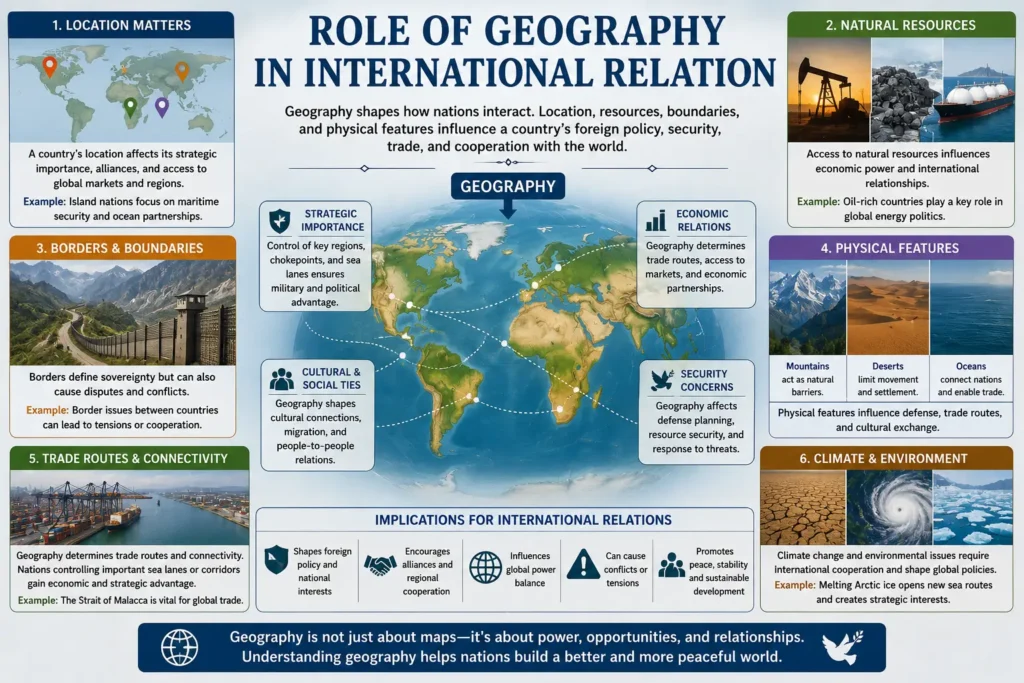
Geography has always shaped how nations interact, compete, and cooperate. From mountain ranges that define borders to oceans that connect continents, geography influences diplomacy, trade, defense, and global politics.
Understanding the role of geography in international relations helps explain why countries form alliances, engage in conflicts, and pursue specific foreign policies.
What Is Geography’s Role in International Relations?
Political geography studies how physical features and spatial relationships affect political decisions. It connects natural landscapes with human strategies for power and influence.
Key Dimensions
- Physical geography: Mountains, rivers, and climate shape national boundaries and defense.
- Human geography: Population, culture, and migration affect diplomacy.
- Economic geography: Resource distribution drives trade and competition.
- Strategic geography: Location determines military and political importance.
Historical Perspective
Geography has guided international relations since ancient times.
Examples
- Egypt and Mesopotamia thrived along river valleys that supported agriculture and trade.
- Greece’s coastal geography encouraged maritime exploration and alliances.
- The Silk Road connected Asia and Europe, shaping cultural and economic exchange.
- Colonial expansion was driven by geographic exploration and resource access.
Geopolitics: The Intersection of Geography and Power
Geopolitics is the study of how geography influences political power.
Key Theories
| Theory | Proponent | Concept |
|---|---|---|
| Heartland Theory | Halford Mackinder | Control of Eurasia ensures global dominance. |
| Rimland Theory | Nicholas Spykman | Coastal regions are key to global power. |
| Sea Power Theory | Alfred Mahan | Naval strength determines influence. |
These theories show how geography shapes military strategy and global leadership.
Geography and Foreign Policy
Countries design their foreign policies based on geographic realities.
Examples
- India’s location between South and Central Asia influences its regional diplomacy.
- Russia’s vast landmass affects its defense and energy strategies.
- Japan’s island geography drives its maritime trade and alliances.
- Middle Eastern nations rely on oil geography for economic and political leverage.
Geography and Global Trade
Trade routes depend on geography — rivers, seas, and mountains determine accessibility.
Key Trade Corridors
| Route | Region | Importance |
|---|---|---|
| Suez Canal | Egypt | Connects Europe and Asia. |
| Panama Canal | Central America | Links Atlantic and Pacific Oceans. |
| Silk Road Economic Belt | Asia‑Europe | Modern trade and investment route. |
Geography also influences resource distribution, shaping trade relations and economic alliances.
Geography and Security
Geography defines national security strategies.
Examples
- Mountain ranges like the Himalayas act as natural barriers.
- Oceans provide defense and trade routes.
- Deserts and forests serve as strategic zones in warfare.
- Border geography affects migration and conflict management.
Countries often use their geographic advantages to strengthen defense and diplomacy.
Climate and Environmental Diplomacy
Climate geography affects international cooperation on environmental issues.
Key Areas
- Climate change negotiations: Nations collaborate to reduce emissions.
- Water resource management: Shared rivers like the Nile and Indus require joint agreements.
- Disaster response: Geography determines vulnerability and aid distribution.
Environmental geography is now central to global diplomacy and sustainable development.
Geography and Cultural Exchange
Geography influences cultural interactions through migration, tourism, and communication.
Examples
- The Mediterranean Sea fostered cultural exchange between Europe, Africa, and Asia.
- Silk Road spread art, religion, and technology.
- Modern globalization connects cultures through digital geography and transport networks.
Cultural geography strengthens international understanding and cooperation.
Geography and International Organizations
Global institutions often form around geographic interests.
Examples
| Organization | Focus Area |
|---|---|
| United Nations (UN) | Global peace and development |
| European Union (EU) | Regional integration |
| ASEAN | Southeast Asian cooperation |
| Arctic Council | Polar region governance |
Geography defines membership, goals, and policies within these organizations.
Technology and Modern Geography
Modern technology has transformed how geography influences international relations.
Innovations
- Satellite mapping for border monitoring.
- GIS systems for resource management.
- Digital connectivity shaping cyber diplomacy.
Technology bridges geographic barriers, creating new forms of global interaction.
Case Studies
1. India and China
Geography shapes their border disputes and trade relations through the Himalayas and Silk Road routes.
2. USA and Russia
Arctic geography influences competition for resources and military presence.
3. Middle East
Desert geography and oil reserves drive global energy politics.
4. European Union
Geographic proximity fosters economic and political integration.
Future of Geography in International Relations
The future will see geography influencing climate diplomacy, resource management, and digital geopolitics.
Emerging Trends
- Arctic exploration for energy and trade.
- Space geography shaping global cooperation.
- Sustainable development linking environment and diplomacy.
Conclusion
Geography is the invisible hand guiding international relations. It shapes borders, trade, culture, and power dynamics.
From ancient river valleys to modern cyberspace, geography continues to define how nations interact and evolve. Understanding this connection is key to building a peaceful and sustainable global future.

