
Introduction
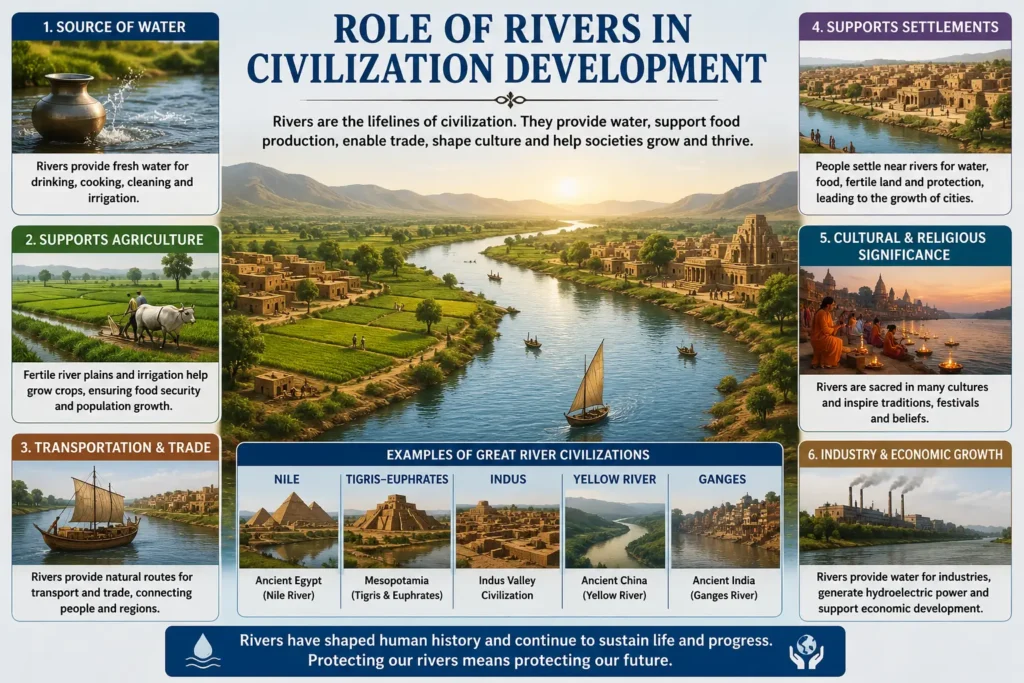
Throughout history, rivers have been the lifelines of human civilization. From the banks of the Nile to the valleys of the Indus, rivers have shaped societies, economies, and cultures. They provided water for drinking and agriculture, routes for trade and transport, and fertile land for settlement.
Understanding the role of rivers in civilization development helps us appreciate how geography influences human progress and how these natural systems continue to sustain life today.
The Importance of Rivers in Human History
Rivers have always been central to human existence. They offered fresh water, fertile soil, and transportation routes, making them ideal locations for early settlements.
Key Contributions
- Agriculture: Irrigation and fertile floodplains supported crop growth.
- Trade and transport: Rivers connected regions and facilitated commerce.
- Urban development: Cities grew along riverbanks.
- Cultural evolution: Rivers inspired myths, religions, and traditions.
- Economic growth: Fishing, farming, and trade boosted prosperity.
Major River Valley Civilizations
Rivers were the cradle of ancient civilizations. Each major civilization developed around a river system that provided resources and connectivity.
| Civilization | River | Region | Key Contributions |
|---|---|---|---|
| Egyptian Civilization | Nile River | Africa | Agriculture, irrigation, trade |
| Mesopotamian Civilization | Tigris & Euphrates | Middle East | Writing, urban planning |
| Indus Valley Civilization | Indus River | South Asia | Drainage systems, trade |
| Chinese Civilization | Yellow River | East Asia | Rice cultivation, technology |
| Mesoamerican Civilization | Amazon & local rivers | South America | Agriculture, cultural diversity |
Rivers and Agricultural Development
Rivers made agriculture possible by providing water for irrigation and nutrient‑rich soil through annual flooding.
Examples
- The Nile’s floods deposited fertile silt, enabling Egypt’s prosperity.
- The Indus River supported advanced farming and urban planning.
- The Yellow River sustained rice cultivation and population growth.
Modern Impact
Even today, river basins like the Ganges, Mississippi, and Yangtze remain agricultural hubs supporting millions of people.
Rivers as Trade Routes
Rivers served as natural highways for trade and communication.
Historical Examples
- The Tigris and Euphrates connected Mesopotamian cities.
- The Rhine and Danube facilitated European commerce.
- The Ganges linked northern India to the Bay of Bengal.
Modern Relevance
Today, rivers like the Amazon, Mississippi, and Yangtze continue to support global trade through inland shipping and port cities.
Rivers and Urbanization
Cities often emerged along rivers due to easy access to water and transportation.
Examples
- London grew along the Thames.
- Paris developed on the Seine.
- Cairo flourished beside the Nile.
- Delhi and Varanasi prospered along the Yamuna and Ganges.
Rivers not only supported population growth but also influenced architecture, planning, and sanitation systems.
Cultural and Religious Significance of Rivers
Rivers hold deep spiritual and cultural meaning across civilizations.
Examples
- The Ganges River is sacred in Hinduism.
- The Nile was worshipped by ancient Egyptians.
- The Jordan River is significant in Christianity.
- The Yangtze symbolizes life and prosperity in Chinese culture.
Rivers became symbols of purity, renewal, and divine connection, shaping rituals and traditions that continue today.
Economic Role of Rivers
Rivers have driven economic growth through fishing, agriculture, trade, and energy production.
Key Economic Activities
- Fishing: Provides food and employment.
- Hydropower: Generates renewable energy.
- Tourism: River cruises and cultural sites attract visitors.
- Transportation: Reduces logistics costs.
Environmental Importance of Rivers
Rivers are vital ecosystems supporting biodiversity and maintaining ecological balance.
Environmental Functions
- Habitat for fish, birds, and plants.
- Water cycle regulation through evaporation and precipitation.
- Soil fertility via sediment deposition.
- Climate moderation through temperature regulation.
Modern Challenges Facing Rivers
Despite their importance, rivers face severe threats due to human activities.
Major Issues
- Pollution from industrial and agricultural waste.
- Deforestation reducing water quality.
- Over‑extraction for irrigation and urban use.
- Dam construction altering natural flow.
- Climate change affecting rainfall and river levels.
Solutions
- River conservation through sustainable management.
- Waste treatment to reduce pollution.
- Afforestation to restore ecosystems.
- Community participation for long‑term sustainability.
Rivers and Modern Civilization
In the modern era, rivers continue to influence development.
Examples
- Hydroelectric dams like Hoover and Bhakra Nangal power cities.
- River ports like Shanghai and Rotterdam drive trade.
- Urban planning integrates rivers for recreation and tourism.
Rivers remain essential for energy, economy, and environment, bridging ancient wisdom with modern innovation.
The Future of Rivers in Civilization
The future depends on how we manage rivers sustainably.
Emerging Trends
- Smart water management using technology.
- Eco‑friendly infrastructure along riverbanks.
- International cooperation for transboundary rivers.
- Renewable energy projects utilizing river flow.
Protecting rivers ensures the survival of civilizations and ecosystems for generations to come.
Conclusion
From ancient Egypt to modern India, rivers have been the foundation of civilization. They nurtured agriculture, trade, culture, and spirituality, shaping human history and progress.
As we face environmental challenges, preserving rivers is not just an ecological necessity — it’s a commitment to our shared heritage and future.

