
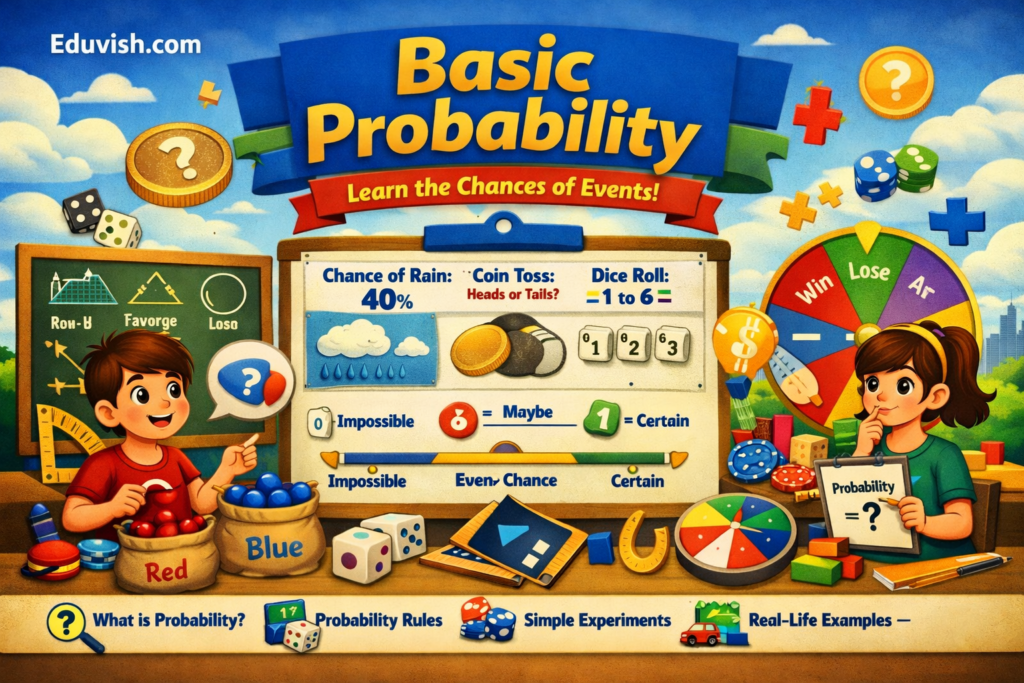
Introduction
Life is full of uncertainties — from predicting the weather to guessing the outcome of a coin toss. Probability helps us measure these uncertainties mathematically. At Eduvish.com, we simplify the concept of basic probability so that students and learners can understand how chances work in everyday life.
Whether you’re calculating the odds of winning a game or estimating the likelihood of rain, probability gives you the power to make informed decisions.
What Is Probability?
Probability is the measure of how likely an event is to occur. It ranges from 0 to 1:
- 0 means the event is impossible.
- 1 means the event is certain.
- Any value between 0 and 1 shows varying degrees of possibility.
For example:
- The probability of getting heads when flipping a coin = ½.
- The probability of rolling a 6 on a dice = 1/6.
Importance of Probability in Daily Life
- Decision making – Helps in making logical choices.
- Risk management – Used in finance, insurance, and business.
- Weather forecasting – Predicts chances of rain or sunshine.
- Games and sports – Determines winning odds.
- Medical research – Calculates chances of recovery or success rates.
Basic Probability Formula
Example: If you roll a dice, the probability of getting a 4 is:
Key Terms in Probability
| Term | Meaning | Example |
|---|---|---|
| Experiment | An action with uncertain results. | Tossing a coin |
| Outcome | The result of an experiment. | Getting heads |
| Event | A set of outcomes. | Getting an even number on a dice |
| Sample Space | All possible outcomes. | {1, 2, 3, 4, 5, 6} |
| Independent Events | Events that don’t affect each other. | Tossing two coins |
| Dependent Events | Events that influence each other. | Drawing cards without replacement |
Types of Probability
1. Theoretical Probability
Based on reasoning and known outcomes. Example: Probability of getting heads = ½.
2. Experimental Probability
Based on actual experiments or observations. Example: If you flip a coin 100 times and get heads 55 times,
3. Compound Probability
Involves two or more events happening together. Example: Probability of getting heads on two coins = ½ × ½ = ¼.
Real-Life Examples of Probability
- Weather prediction – “There’s a 40% chance of rain.”
- Lottery and games – Calculating winning odds.
- Medical diagnosis – Estimating recovery chances.
- Traffic analysis – Predicting congestion patterns.
- Sports analytics – Evaluating player performance.
Probability Rules
- Rule of Addition: For mutually exclusive events,
Example: Probability of rolling a 2 or 3 = 1/6 + 1/6 = 1/3.
- Rule of Multiplication: For independent events,
Example: Probability of getting heads on two coins = ½ × ½ = ¼.
- Complementary Rule:
Example: If the chance of rain is 0.3, the chance of no rain = 1 – 0.3 = 0.7.
Fun Probability Experiments
- Tossing coins and recording outcomes.
- Rolling dice and noting frequencies.
- Drawing colored balls from a bag.
- Spinning a wheel and predicting results.
These simple experiments help visualize how probability works in real life.
Common Mistakes Students Make
- Confusing independent and dependent events.
- Forgetting to count all possible outcomes.
- Mixing theoretical and experimental probabilities.
- Ignoring complementary probabilities.
How to Master Probability
- Practice with real-life examples.
- Use probability charts and diagrams.
- Solve quizzes and puzzles on Eduvish.com.
- Visualize outcomes using graphs.
- Apply probability in games and daily decisions.