
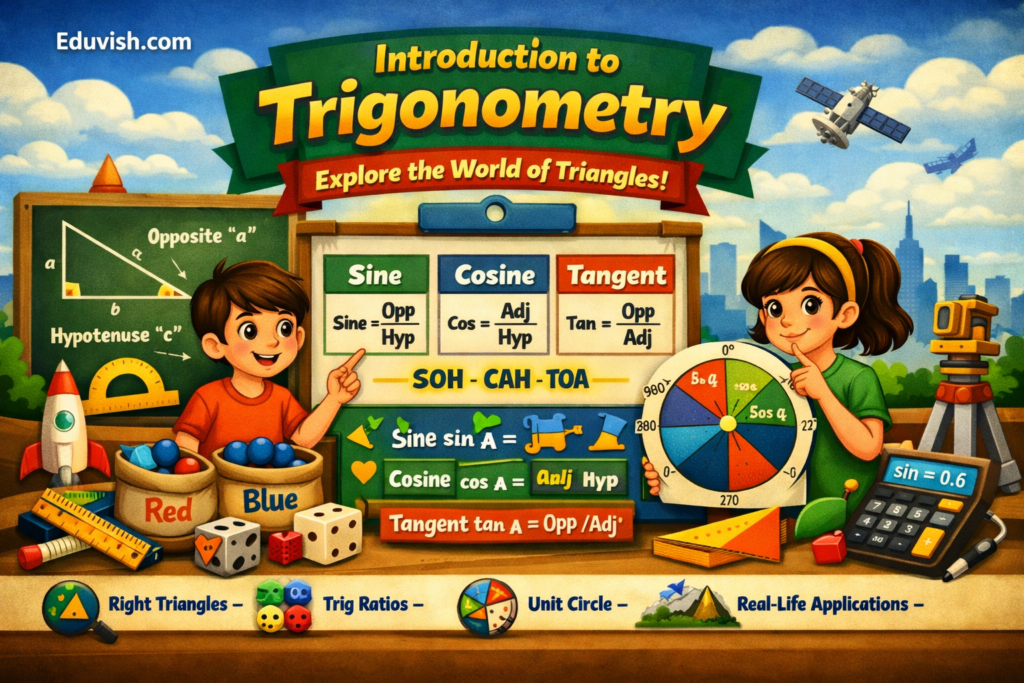
Introduction
Trigonometry is one of the most fascinating branches of mathematics that connects geometry and algebra through angles and ratios. It helps us understand the relationship between the sides and angles of triangles — especially right-angled triangles. At Eduvish.com, we make trigonometry basics simple and practical so learners can apply it in real life, from measuring heights to designing buildings.
What Is Trigonometry?
The word trigonometry comes from Greek roots: “trigonon” (triangle) and “metron” (measure). It is the study of angles, sides, and their relationships in triangles.
Trigonometry is used in:
- Architecture and engineering
- Astronomy and physics
- Navigation and surveying
- Computer graphics and robotics
Importance of Trigonometry
- Measurement of heights and distances – Used to calculate the height of buildings or mountains.
- Navigation – Helps ships and aircraft find directions.
- Design and construction – Used in architecture and civil engineering.
- Physics and astronomy – Calculates angles of motion and celestial positions.
- Technology and graphics – Used in computer simulations and animations.
Basic Trigonometric Terms
| Term | Definition | Example |
|---|---|---|
| Angle | Formed by two rays meeting at a point. | 30°, 45°, 90° |
| Hypotenuse | The longest side opposite the right angle. | Side “c” in a right triangle |
| Opposite side | The side opposite to the angle being measured. | Side “a” |
| Adjacent side | The side next to the angle being measured. | Side “b” |
Trigonometric Ratios
Trigonometric ratios relate the sides of a right-angled triangle to its angles. The three main ratios are:
| Function | Formula | Mnemonic |
|---|---|---|
| Sine (sin) | sin A = Opposite / Hypotenuse | SOH |
| Cosine (cos) | cos A = Adjacent / Hypotenuse | CAH |
| Tangent (tan) | tan A = Opposite / Adjacent | TOA |
👉 Remember the formula using SOH-CAH-TOA.
Reciprocal Ratios
| Function | Formula |
|---|---|
| Cosecant (csc) | csc A = 1 / sin A |
| Secant (sec) | sec A = 1 / cos A |
| Cotangent (cot) | cot A = 1 / tan A |
Trigonometric Values for Common Angles
| Angle | sin A | cos A | tan A |
|---|---|---|---|
| 0° | 0 | 1 | 0 |
| 30° | ½ | √3/2 | 1/√3 |
| 45° | √2/2 | √2/2 | 1 |
| 60° | √3/2 | ½ | √3 |
| 90° | 1 | 0 | Undefined |
Trigonometric Identities
These are formulas that hold true for all angles.
- sin²A + cos²A = 1
- 1 + tan²A = sec²A
- 1 + cot²A = csc²A
These identities are the backbone of trigonometric calculations.
Real-Life Applications of Trigonometry
- Architecture – Designing roofs, bridges, and towers.
- Astronomy – Measuring distances between stars.
- Engineering – Calculating forces and angles.
- Navigation – Determining position and direction.
- Music and sound waves – Understanding wave patterns.
Unit Circle in Trigonometry
The unit circle is a circle with a radius of 1 centered at the origin. It helps define trigonometric functions for all angles.
- sin θ = y-coordinate
- cos θ = x-coordinate
- tan θ = sin θ / cos θ
Angles are measured in degrees or radians around the circle.
Trigonometric Graphs
Each trigonometric function has a unique graph:
- sin θ – Wave pattern starting at 0.
- cos θ – Wave pattern starting at 1.
- tan θ – Repeats every 180°.
These graphs are used in physics, engineering, and signal processing.
Common Mistakes Students Make
- Confusing opposite and adjacent sides.
- Forgetting the SOH-CAH-TOA rule.
- Mixing degrees and radians.
- Ignoring trigonometric identities.
Tips to Learn Trigonometry Easily
- Visualize triangles and angles.
- Practice with real-world examples.
- Use trigonometric tables and calculators.
- Apply formulas regularly.
- Solve quizzes and interactive problems on Eduvish.com.

